
Live streaming and social platforms are no longer just traffic channels for cross-border merchants entering Malaysia. They are increasingly becoming conversion channels. In a market where digital commerce is already mature, the payment experience has a direct impact on whether viewers, followers, and mobile-first shoppers complete their purchases. Malaysia’s digital economy remains significant, and its payments environment is shaped not only by cards, but also by online banking and e-wallet usage.
For merchants selling through live commerce, creator-led recommendations, short-form content, and social storefronts, checkout speed matters. Customers often make fast purchase decisions in these environments. If the payment process feels unfamiliar, offers too few choices, or creates unnecessary friction, conversion can drop quickly. That is why cards alone are often not enough in Malaysia. FPX is positioned by PayNet as a secure real-time online banking payment method, while BoostBiz, ShopeePay, and Touch ’n Go all present merchant-facing solutions relevant to digital and mobile commerce.
Why Localized Payment Acceptance Matters in Malaysia
A localized checkout is not just about language and currency. It is also about offering payment methods customers already know and trust.
In Malaysia, many online and social-commerce transactions are completed through a mix of card payments, bank-linked payments, and e-wallets. For a cross-border merchant, this means one important thing: if checkout only supports international credit cards, part of local payment intent may be lost before payment is completed. A more localized payment setup can better match actual customer behavior and improve payment completion.
Local Payment Methods That Matter for Malaysia Live and Social Commerce
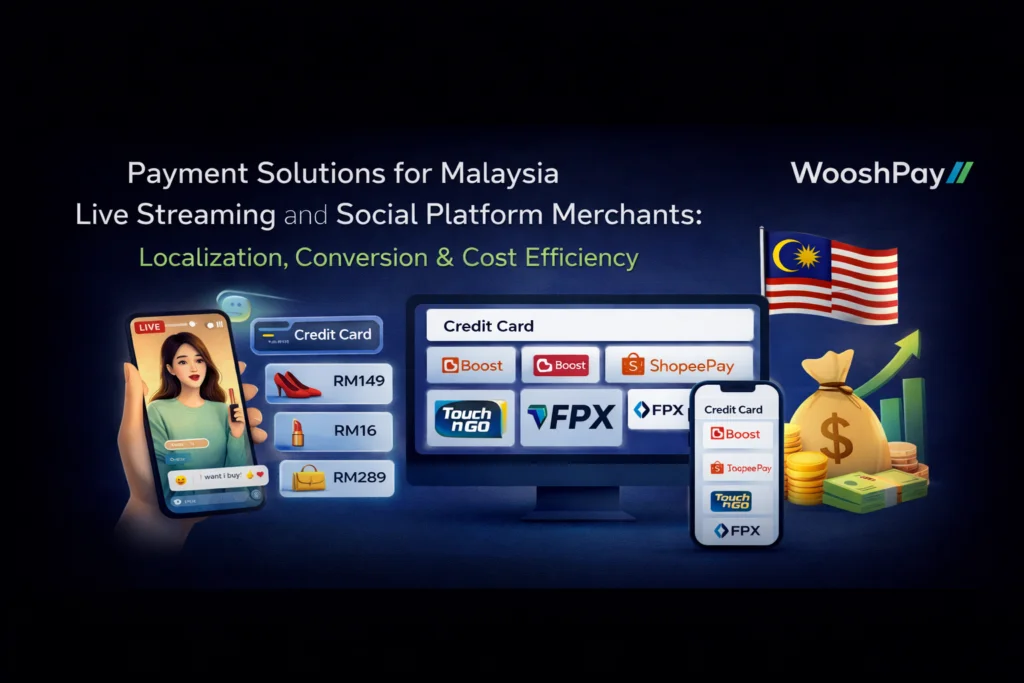
WooshPay helps merchants support:
- Cartão de crédito
- Impulsionar
- ShopeePay
- Touch ‘n Go
- FPX
This combination is especially valuable for live streaming and social platform merchants.
Credit cards remain essential for international shoppers, higher-value purchases, and general cross-border acceptance. But local payment methods are what make checkout feel more familiar to Malaysian consumers. FPX supports trusted online banking flows. Boost and ShopeePay are wallet-based options that fit well with mobile commerce. Touch ’n Go is also closely aligned with flexible merchant models, including online sellers and part-time businesses.
How WooshPay Helps Cross-Border Merchants
WooshPay is not only about adding more payment methods. Its advantage is that it helps cross-border merchants bring card acceptance and local payment methods into one payment strategy, while keeping the setup easier to manage. That positioning is consistent with WooshPay’s existing market-facing copy in other regions, which emphasizes comprehensive local method support, streamlined integration, secure and reliable processing, simplified operations, and stronger conversion or cost efficiency outcomes.
- Better Checkout Localization
When customers see familiar methods such as FPX, Boost, ShopeePay, and Touch ’n Go, checkout feels more local and more trustworthy. That matters even more in social and live-commerce journeys, where buying intent is often immediate and fragile.
- Higher Conversion Potential
Different customers want different ways to pay. Some prefer cards. Some prefer online banking. Some are more comfortable with wallets. By supporting both cards and local methods, merchants can cover a broader range of payment preferences and reduce unnecessary drop-off.
- A Better Fit for Live Streaming and Social Commerce
Live and social transactions are often mobile-first and impulse-driven. In those moments, payment friction matters more than ever. A payment stack that reflects local user habits is better positioned to turn engagement into completed orders.
- Simpler Operations
Managing multiple payment providers separately can increase integration work, operational coordination, and reporting complexity. A more unified setup helps cross-border teams launch faster and manage Malaysia more efficiently.
- Better Cost Efficiency
The real cost of payments is not limited to headline transaction fees. It also includes technical integration, operational management, reconciliation, and payment maintenance. A more centralized solution can help merchants improve overall efficiency as they scale.
Why This Matters for Growth
For cross-border merchants, the Malaysia payments question is no longer just whether customers can pay. The more important question is whether customers can pay in the way they already prefer.
That is where WooshPay creates value in this scenario. By supporting Credit Card, Boost, ShopeePay, Touch ‘n Go, and FPX, WooshPay helps merchants build a payment experience that is more localized, more conversion-friendly, and easier to operate for live streaming and social platform selling.
Perguntas frequentes
Is credit card acceptance enough for Malaysia live commerce?
Usually not. Credit cards remain important, but Malaysia’s payment environment also includes strong online banking and e-wallet behavior, which matters for mobile-first and social-driven transactions.
Which local payment methods can merchants support through WooshPay in this setup?
Based on the scope provided here: Boost, ShopeePay, Touch ‘n Go, and FPX, alongside cartões de crédito.
Why are local payment methods important for social commerce?
Because social-commerce purchases are often fast and mobile-led. Familiar payment methods can reduce friction and improve checkout completion.
What is the main advantage of using WooshPay?
A more unified payment setup that combines card acceptance with local methods, helping merchants improve localization, conversion, operational simplicity, and cost efficiency. That positioning is aligned with WooshPay’s existing market copy patterns in other regions.