
As AI agents become more capable, they are moving beyond answering questions and generating content. The next stage is action: searching for information, comparing services, calling APIs, purchasing data, booking tools, and completing business workflows on behalf of users. This shift is giving rise to a new category of commerce: agentic commerce, where software agents can make decisions and initiate transactions programmatically.
For this future to work, AI agents need more than intelligence. They need payment capabilities. Traditional payment flows were designed for human checkout, card entry, account login, and manual authorization. AI agents, however, need payment infrastructure that is programmable, secure, automated, and compatible with machine-to-machine interactions.
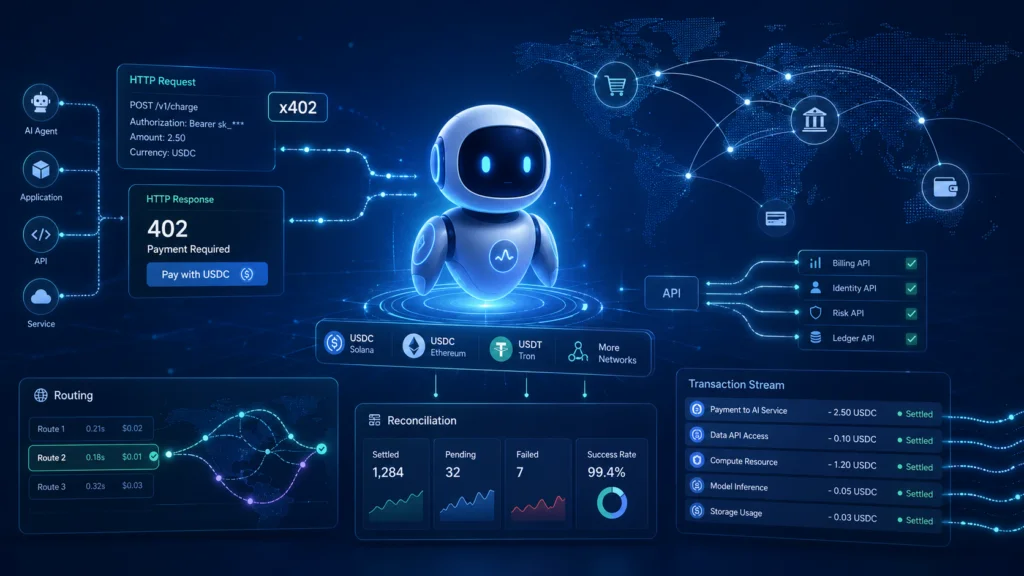
This is where Pagos de agentes de IA y el x402 protocol become important. x402 introduces a way for APIs, applications, and digital services to request and receive payment directly through HTTP, using the long-reserved 402 Payment Required status code. It is designed to let human developers and AI agents pay for access to APIs, content, and digital resources without traditional account-based payment flows.
At the same time, the broader AI payment economy will require more than one protocol. Businesses will still need global payment acceptance, local payment methods, intelligent routing, fraud prevention, compliance, reconciliation, and settlement infrastructure. This is where payment infrastructure providers such as WooshPay can play a meaningful role.
What Is the x402 Protocol?
En x402 protocol is an open payment protocol built around HTTP 402 Payment Required. Instead of treating payment as a separate checkout process, x402 allows a server to respond to a request with payment instructions. The client, which may be a human-operated app, a programmatic service, or an AI agent, can then complete payment and retry the request with proof of payment.
In a typical x402 flow:
- A client requests a paid resource, such as an API endpoint or digital service.
- The server returns
402 Payment Requiredwith payment details. - The client creates a signed payment payload.
- The client retries the request with the payment signature.
- The server verifies and settles the payment.
- The server returns the requested resource.
This model makes x402 especially relevant for machine-to-machine payments, pay-per-use APIs, micropaymentsy AI agents that autonomously pay for API access. Coinbase’s x402 documentation describes it as a protocol for instant, automatic stablecoin payments over HTTP, while x402’s own documentation positions HTTP 402 as a foundation for API-native payments.
Why AI Agents Need Native Payment Capabilities
AI agents are becoming active participants in digital workflows. A business agent may need to purchase market data, call a risk-scoring API, access a premium database, or pay for compute resources. A consumer agent may compare travel options, reserve a service, or buy digital goods. A developer agent may use paid tools, paid MCP services, or paid API calls while completing a task.
These use cases create a new requirement: autonomous payments.
Traditional payment methods are not always ideal for this environment. Cards, subscriptions, and bank transfers often depend on accounts, invoices, dashboards, manual approvals, or user interfaces. They work well for many human-led transactions, but they are less natural for small, frequent, machine-triggered payments.
AI agents need payment systems that can support:
- Programmatic authorization
- Low-friction API access
- Usage-based billing
- Real-time or near-real-time payment confirmation
- Clear spending limits and permission controls
- Machine-readable receipts and reconciliation data
This is why Pagos de agentes de IA are likely to become an important part of the next generation of payment infrastructure.
x402 and the Rise of Agentic Commerce
The x402 protocol is not just a technical experiment. It reflects a broader shift toward agentic payments y agentic commerce.
In the current web, users often create accounts, store cards, subscribe to services, and manually approve purchases. In an agentic web, AI agents may request services directly and pay only when a resource is needed. For example:
- An AI research agent pays for one premium dataset.
- A coding agent pays for a specialized debugging API.
- A trading assistant pays for real-time market data.
- A content agent pays to unlock a paywalled article.
- A SaaS agent pays per request instead of subscribing monthly.
This could change how APIs and digital services are monetized. Instead of forcing every buyer into a subscription, providers could offer pay-per-use APIs, paid MCP toolsy usage-based access for AI agents. Cloudflare’s x402 documentation also highlights use cases around HTTP content, agents, and programmatic clients paying without accounts, sessions, or API keys.
What AI Agent Payments Mean for the Payments Industry
The rise of AI agent payments could reshape the payments industry in several ways.
First, checkout may evolve from human checkout a agent checkout. In traditional e-commerce, the buyer sees a checkout page, chooses a payment method, and confirms the purchase. In agentic commerce, the AI agent may execute payment within a defined permission framework.
Second, billing may shift from subscriptions to usage-based payment models. APIs, data providers, and digital platforms may charge per call, per result, per task, or per workflow.
Third, payment orchestration will become more important. AI agents may not rely on one payment rail. Depending on transaction type, geography, currency, risk level, settlement speed, and cost, businesses may need different routes for different payments.
Fourth, risk management will become more complex. Payment systems will need to understand not only the merchant and the end user, but also the agent acting between them. This raises new questions: Who authorized the agent? What is the agent allowed to buy? What spending limit applies? How should suspicious agent behavior be detected?
Finally, reconciliation will become more important. If AI agents trigger many small transactions across APIs, wallets, cards, local payment methods, and stablecoin rails, finance teams will need unified reporting and automated reconciliation to understand what happened.
Where WooshPay Fits in the Future of AI Payments
The x402 protocol addresses an important protocol-layer question: how can a machine or AI agent pay for a web resource programmatically?
But businesses also need a broader infrastructure layer. They need to accept payments globally, route transactions intelligently, support local payment methods, reduce payment failures, manage reconciliation, and maintain compliance.
WooshPay is positioned as a payments infrastructure provider for businesses operating across markets. Its public website describes support for 195 countries and regions, over 50 payment methods, 160 fiat currencies, and 15+ cryptocurrencies. It also highlights dynamic routing, intelligent retry, one dashboard, and unified reconciliation.
For merchants and platforms preparing for AI commerce, this matters because AI-driven transactions will not exist in isolation. They will still connect to real-world business needs:
- Global payment acceptance
- Localized checkout experiences
- Multi-currency processing
- Fraud protection
- Settlement management
- Financial reporting
- Conciliación unificada
WooshPay’s Gateway Service also emphasizes payment integration, global payment corridors, no-code addition of new payment methods and payment service providers, intelligent routing, and multi-channel unified reconciliation in one backend.
This makes WooshPay relevant not as a replacement for x402, but as part of the broader payment infrastructure that businesses will need as AI commerce grows.
x402 vs. Payment Orchestration: Different Layers, Complementary Roles
The future of AI payments will likely require both protocol innovation and infrastructure orchestration.
| Layer | x402 Protocol | WooshPay Payment Infrastructure |
|---|---|---|
| Main role | Programmatic payment over HTTP | Global payment acceptance and management |
| Typical use case | AI agent pays for an API or digital resource | Merchant accepts and manages payments across markets |
| Core value | Machine-native payment flow | Local methods, routing, reconciliation, settlement |
| Payment context | API, content, data, tools | E-commerce, platforms, digital services, cross-border business |
| Business need | Monetize resources per request | Improve success rate, reduce complexity, unify operations |
In other words, x402 can help make web resources payable by machines. WooshPay can help businesses manage the larger payment environment around global acceptance, routing, and reconciliation.
Challenges Ahead for AI Agent Payments
AI agent payments are promising, but they also introduce new challenges.
Authorization will be critical. Businesses and consumers must define what an AI agent is allowed to buy, how much it can spend, and when human approval is required.
Seguridad will become more complex. Payment systems will need to distinguish legitimate automated behavior from abuse, fraud, or compromised agents.
Conformidad will remain essential. AI payments may involve fiat, stablecoins, local payment methods, wallets, and cross-border settlement. Each of these can create regulatory and reporting obligations.
Disputes and refunds will need new rules. If an AI agent purchases the wrong API call, books the wrong service, or pays for a resource that does not meet expectations, businesses will need clear refund and dispute processes.
Reconciliation will be a major operational requirement. As machine-triggered payments increase, companies will need automated systems to match orders, payment instructions, settlements, fees, and reports.
These challenges show why the future of AI payments will not be solved by a single technology. It will require a combination of protocols, payment gateways, orchestration engines, compliance tools, and financial operations infrastructure.
Conclusion: AI Agents Will Need More Than a Payment Protocol
AI agents are changing how digital services are discovered, selected, and consumed. As these agents become more autonomous, payments must become more programmable.
The x402 protocol is an important step toward machine-native payments. By using HTTP 402 Payment Required, it gives APIs, applications, and digital services a way to request payment directly inside standard web interactions. This can unlock new models for API monetization, pay-per-use services, paid MCP tools, and autonomous agent workflows.
But the broader opportunity is bigger than x402 alone. The future of Pagos de agentes de IA will also require global payment acceptance, local payment methods, intelligent routing, fraud prevention, compliance, settlement, and unified reconciliation.
That is where WooshPay’s payment infrastructure can fit into the larger picture. As agentic commerce grows, businesses will need a payment partner that can help them manage complexity across markets, currencies, methods, and payment rails.
AI agents may become the next generation of digital buyers. Payment infrastructure will determine how easily they can transact.
FAQ
1.What is the x402 protocol?
The x402 protocol is an open payment protocol built around HTTP 402 Payment Required. It allows servers to request payment directly through HTTP and allows clients, including AI agents, to pay programmatically for APIs, content, or digital resources.
2.Why do AI agents need payment capabilities?
AI agents need payment capabilities because they may need to purchase data, access paid APIs, use digital tools, or complete transactions on behalf of users or businesses.
3.What are AI agent payments?
AI agent payments are transactions initiated or completed by AI agents within defined rules, permissions, and spending limits.
4.How does x402 support AI agent payments?
x402 supports AI agent payments by allowing a service to return payment requirements through HTTP and allowing the agent to retry the request with a signed payment payload.
5.Is x402 the same as a payment gateway?
No. x402 is a protocol for programmatic payments over HTTP. A payment gateway or payment infrastructure provider helps businesses accept, route, manage, reconcile, and settle payments across markets and payment methods.
6.How can WooshPay support the future of AI commerce?
WooshPay can support AI commerce by helping businesses manage global payment acceptance, local payment methods, intelligent routing, multi-currency operations, fraud protection, and unified reconciliation.