
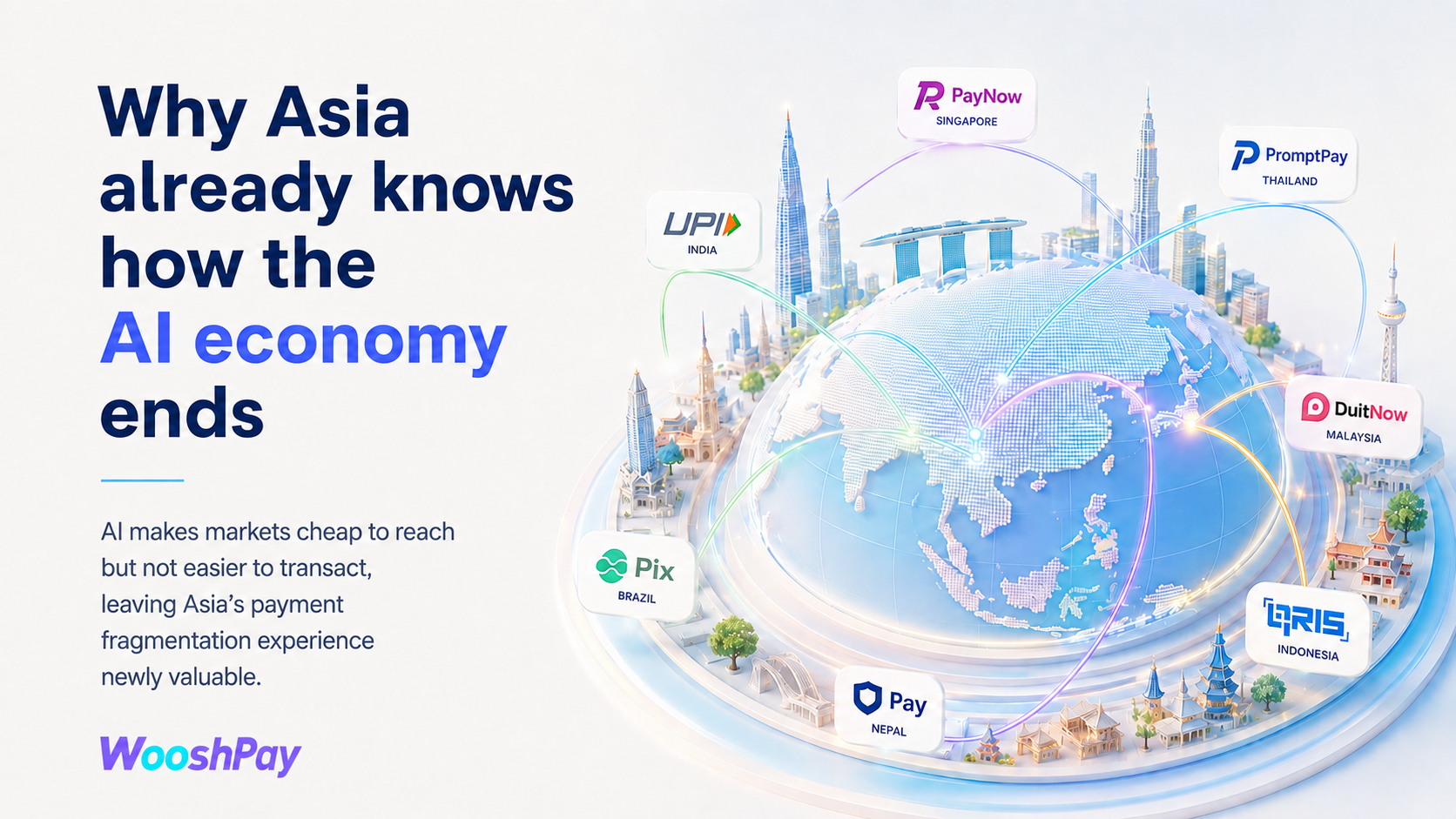
AI makes markets cheap to reach but not easier to transact, leaving Asia’s payment fragmentation experience newly valuable
By Zhiguo Ma
There is a comfortable assumption running through most conversations about artificial intelligence: that it will flatten the world. That a capable enough model, trained once, will serve a customer in Jakarta as easily as one in Frankfurt, and that the frictions that made global expansion slow and costly will quietly dissolve.
Half of that is true. AI is collapsing the cost of building and scaling a business that operates everywhere at once. A founder today can run localised product and operations across a dozen countries with a team that a decade ago covered two. The marginal cost of reaching a new market is falling towards zero.
But reaching a market and transacting in one are very different things, and it is the second that AI is not making any easier.
The software is converging, the settlement layer is not
Most discussion about AI fixates on what is genuinely becoming a global commodity: models, chips, talent, capital. These flow across borders ever more easily. What does not is everything underneath an actual transaction. Payments, regulation, digital identity, data governance, and plain consumer habit remain stubbornly, almost defiantly local.
Consider how someone pays. In India it is likely UPI. In Singapore, PayNow. In Indonesia, QRIS. In Brazil, Pix. Each works smoothly inside its own borders and stops at them, carrying its own rules on settlement, refunds, identity, and disputes. None is a card network with a tidy global standard on top.
This is not a transitional state on the way to uniformity. It is the destination. Digital wallets now account for 56 per cent of e-commerce value and a third of in-store value worldwide, yet the methods inside those wallets diverge sharply by market. Alternative payment methods are on track to power close to 70 per cent of global e-commerce by 2029, while cash still represents 46 per cent of payments. And these rails are not small: India’s UPI alone clears over 20 billion transactions a month, near half the world’s real-time payments. The world is not settling on one way to move money. It is multiplying ways.
An obvious objection: won’t stablecoins become the universal rail that flattens this? Not yet. Despite headline volumes that now rival Visa, real stablecoin payments amount to roughly 0.02 per cent of global flows, and around 60 per cent of those sit in Asia. Even the borderless rail is, in practice, small and disproportionately Asian.
This matters because of where growth is heading. Emerging markets hold 85 per cent of the world’s population and are set to drive about 65 per cent of global growth by 2035. The next billion customers are mobile-first and uninterested in a foreign checkout.
Agentic commerce makes the gap wider, not narrower
The temptation is to assume autonomous agents paper over all this: you ask one to book the trip or settle the invoice, and it handles the mess.
But hand the problem to an agent and the hard questions do not disappear. They sharpen. Which rail does it use? In which currency? Under whose regulatory regime? Who authorised the spend, and how is that proven if something goes wrong? AI agents could mediate three to five trillion dollars of consumer commerce by 2030, and half of all consumers already use AI to begin a search. The model is the easy part. Trust, identity, permissions, and cross-border settlement are the hard part, and they are exactly the parts that remain local.
Agentic commerce, then, does not abstract fragmentation away; it pushes that complexity right up against the point of payment. An agent that cannot navigate local rails cannot actually buy anything.
Asia has been living in this future for a decade
Here the usual narrative inverts. Fragmentation is normally framed as a problem to be solved with a clean global standard. But much of Asia never had a uniform market, and rather than wait for one, it learned to operate inside the mess.
The interesting work has not been homogenisation. It has been interoperability without erasure. India and Singapore linked UPI and PayNow directly; Singapore and Malaysia connected PayNow and DuitNow; India and Thailand bridged UPI and PromptPay. Project Nexus, taken forward in 2025 by five Asian central banks and joined by Indonesia in 2026, connects these fast-payment systems on shared rails while letting each keep its own. UPI is now accepted by merchants from Nepal to the UAE; Pix has begun appearing well beyond Brazil.
The skill being built here is less technical than temperamental: connect to local reality rather than override it, design compliance in rather than bolt it on, and treat the right set of payment methods as the difference between a shopper and a customer. A transferable competence, and about to become far more valuable.
This was the conviction behind starting WooshPay: that the businesses scaling fastest in the AI era would need would need a next-generation payments infrastructure built for plurality from day one, not retrofitted once one market stopped being enough.
What this means if you are building
For founders and operators, the implications are concrete. Treat payments and compliance as commercial strategy, not back-office plumbing to be solved later; in most high-growth markets the local method decides conversion. The economics reinforce the point: Datos Insights finds that digital-first institutions in Asia run cost-to-income ratios below 35 per cent, against 50 per cent or more for legacy models. Build for plurality from the start, across many rails and identity regimes, because retrofitting that is far more painful than designing for it.
The deeper shift is in where competitive advantage lives. When AI makes the product cheap to build and easy to copy, the edge moves downstream, to the unglamorous work of landing it cleanly in each market. The winners of the AI era will not simply be the firms with the best technology. They will be the ones who can navigate complexity across many markets at once.
So here is the future worth sitting with. AI will make it trivially easy to reach every market on earth, and surprisingly hard to actually transact in any of them. The frontier moves from building the thing to landing it. And the regions that never enjoyed the luxury of a single, tidy market, the ones that learned to connect without flattening, may turn out to have been writing the playbook all along, for an economy that is global in its ambition and local in its execution.
Zhiguo Ma is the Founder and CEO of WooshPay.
This article was orignially published on e27 on 8 July 2026.